

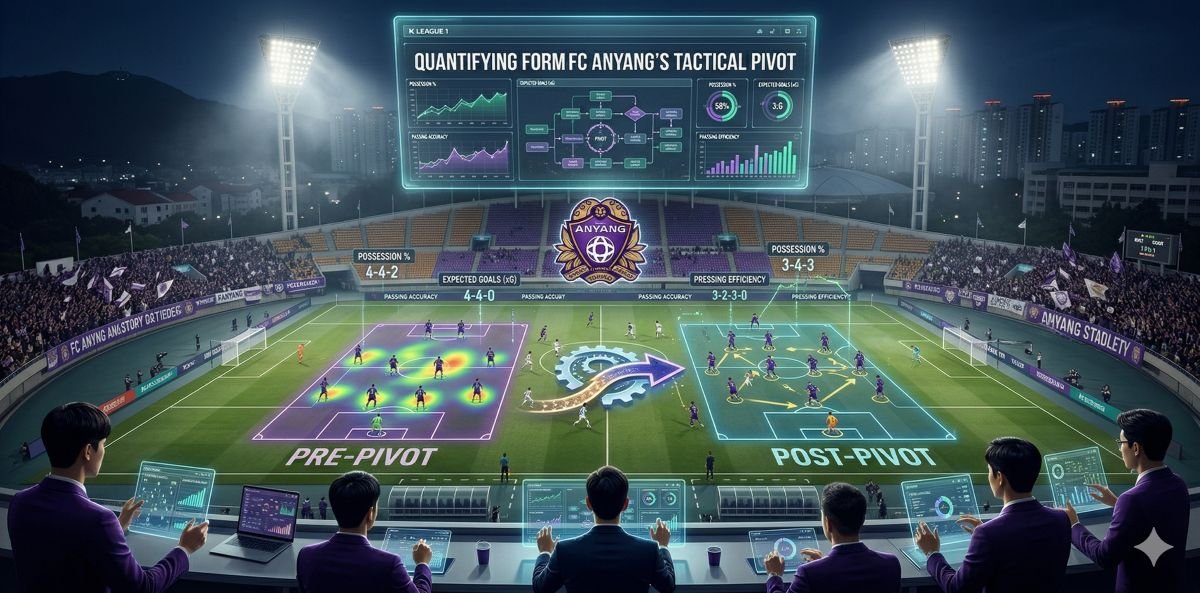
For followers of FC Anyang, the transition to K League 1 has been a rigorous test of both the club’s athletic depth and its management’s analytical resilience. Following the 1–1 draw against Gimcheon Sangmu on April 12, 2026, a significant shift has emerged in the club’s operational philosophy. Under Head Coach Yoo Byung-hoon, Anyang has pivoted from its traditional back-three defensive setup to a more compact 4-3-3 formation.
This change was not merely a reaction to recent scores, but a calculated “tactical pivot” driven by internal performance data and “form stability” metrics. For the analytically-minded fan, this Round 7 match provides a clear case study in how modern football institutions prioritize structural efficiency over traditional experience.
The Shift to 4-3-3: Targeting High-Value Zones
In the opening rounds of the 2026 season, FC Anyang frequently utilized a three-center-back system designed to provide width and offensive flexibility. However, internal data indicated a vulnerability in the “High-Value Zones”—the critical areas just outside the penalty box and the half-spaces where elite K League 1 attackers operate with high efficiency.
The transition to a 4-3-3 formation in Round 7 represents a move toward defensive density. By utilizing four at the back, Anyang effectively narrowed the vertical lanes available to Gimcheon’s counter-attack. The structural goal was to force the opposition into lower-probability shooting areas, thereby reducing the “Expected Goals Against” ($xGA$).
This decision was reportedly grounded in “stability scores,” a metric that evaluates how consistently a tactical shape can withstand pressure without fracturing. When a team undergoes such a shift, it is often a response to distinguishing essential changes in momentum from statistical noise, ensuring that the coaching staff is reacting to long-term patterns rather than a single unlucky bounce.
Performance Metrics Over Historical Tenure
Perhaps the most discussed aspect of the Gimcheon match was the selection of goalkeeper Kim Jeong-hoon. In professional sports, the “incumbent advantage”—the tendency to start experienced veterans over younger players—is often a hard-to-break cultural norm. However, Kim’s inclusion over more seasoned squad members was justified through recent training and match stability scores.
The management’s reliance on “Current Statistical Output” over “Historical Tenure” reflects a broader trend in Gyeonggi-do sports culture:
Reflex Latency: Data showed Kim’s reaction times in training were peaking, providing a marginal but statistically significant advantage in close-range shot-stopping.
Distribution Accuracy: The 4-3-3 requires the goalkeeper to act as the first point of distribution. Kim’s “Pass Completion under Pressure” metric was the highest in the squad for the preceding two-week cycle.
By prioritizing these metrics, FC Anyang is moving toward a meritocracy defined by data. This transparency in selection helps build foundational trust within the squad and the community, showing that roles are earned through objective performance rather than seniority alone.
Quantifying Stability: The Goal Differential Trend
To understand why the coaching staff prioritized defensive structure in Round 7, fans are encouraged to look at the club’s Goal Differential ($G_{diff}$). This simple yet vital statistic is the most reliable predictor of a team’s long-term league standing.
The formula for calculating this trend is:
After 7 rounds, FC Anyang sits at a -1 differential. While the club has been competitive in every match, a negative differential over time suggests that the offense is being forced to over-perform to compensate for defensive lapses. The move to a compact 4-3-3 is a structural attempt to pull that differential back into positive territory.
Instead of searching for a “star” signing to score more goals (a personnel solution), the club is using a “structural solution”—tightening the formation to ensure that even on days when the offense is quiet, the defense can secure a point. This analytical approach was previously highlighted in our look at analyzing the expected points gap and Anyang’s defensive profile, where the early-season data suggested a correction was imminent.
The Educational Takeaway for Fans
For the Anyang community, following FC Anyang in the top flight requires a new level of sports literacy. A 1–1 draw against a disciplined side like Gimcheon Sangmu might feel like a missed opportunity on the surface. However, when viewed through the lens of tactical pivots and form stability, it represents a successful “stress test” of a new system.
The 4-3-3 formation provided the following structural benefits in Round 7:
Reduced Space in Half-Spaces: Gimcheon’s playmakers were forced to the wings.
Sustained Midfield Pressure: Three central midfielders allowed for a more consistent “press-and-cover” rhythm.
Statistical Leveling: By limiting high-value entries, Anyang maintained a draw despite having less total possession.
As the season progresses, the ability to pivot based on data—rather than emotion—will be the defining characteristic of Anyang’s survival and growth in K League 1. By quantifying form, the club isn’t just playing the game; they are engineering a sustainable future in the top tier of Korean football.