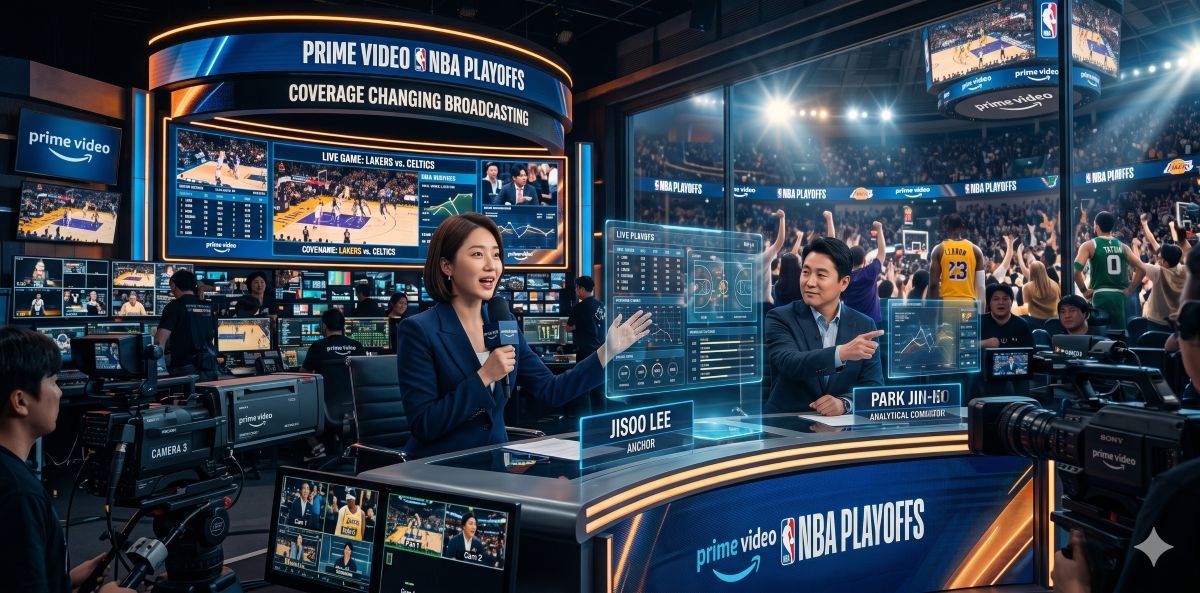

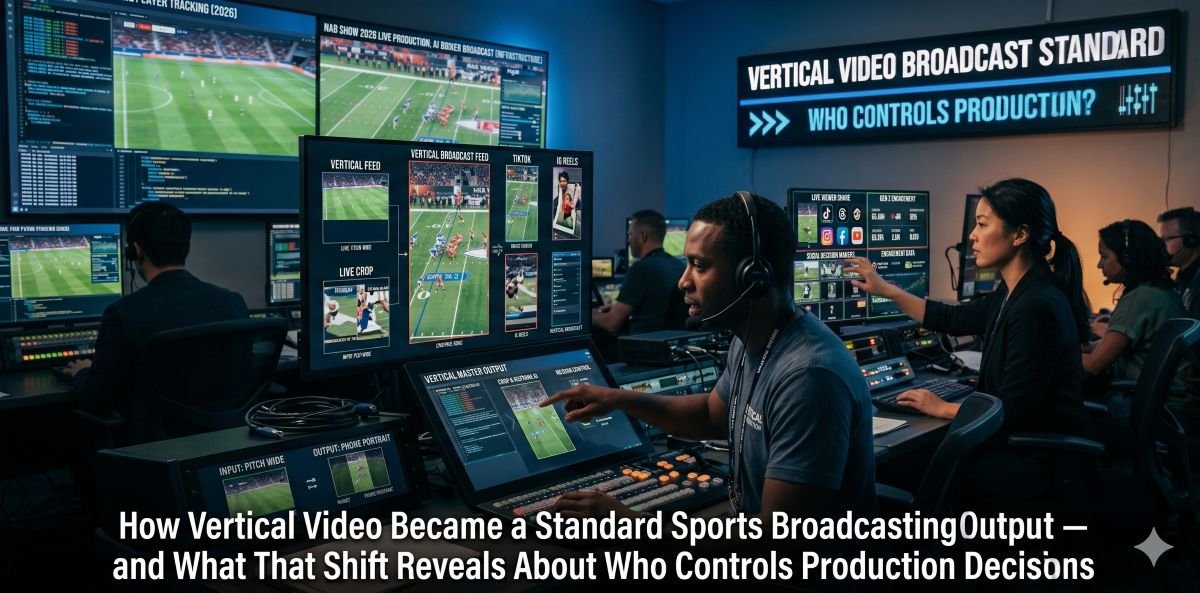
For most of the past century, sports broadcasting was built around a single screen orientation: horizontal. The 16:9 widescreen frame became synonymous with professional production quality. Stadiums, camera rigs, editing suites, and broadcast trucks were all designed around it. For decades, the rectangle that sat in someone’s living room was the fixed endpoint that every production decision worked toward.
That orientation is no longer fixed. The dominant screen for sports content consumption in 2026 is held vertically, and broadcasters who have not restructured their production workflows to account for this are producing content that arrives on most viewers’ devices already cropped, rotated, or formatted incorrectly.
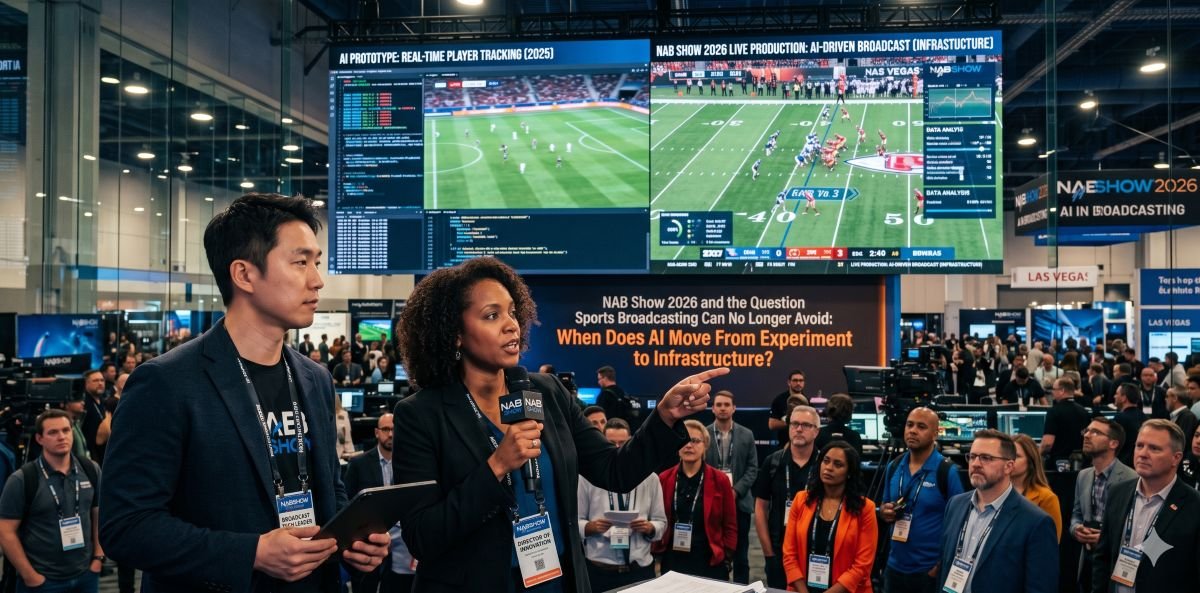
The structural shift in how vertical video became a production standard — not an afterthought — is the story that the 2026 NAB Show broadcasting industry conference (April 18–22, Las Vegas) is placing at the center of its sports media agenda.
From Manual Afterthought to AI Infrastructure
Until recently, vertical video in sports broadcasting was produced through a largely manual process. A production team would monitor the main broadcast feed, identify a key moment — a goal, a dunk, a sprint — clip it from the horizontal master recording, and then manually reframe it for a 9:16 aspect ratio optimized for mobile and social platforms. The process took time, required dedicated staff, and inevitably ran behind the live moment that drove its value.
According to NewscastStudio’s NAB preview, broadcasters including NBCUniversal and Fox Sports Digital have begun deploying AI-powered tools to automate this process, with the conversion now happening in parallel with live encoding rather than as a post-production step. The result is a vertical video output generated within six to ten seconds of the moment occurring on air — a latency reduction that fundamentally changes the relationship between a live sports event and its mobile audience.
The system behind this, AWS Elemental Inference, uses computer vision to automatically detect the relevant action in a horizontal feed, crop and reframe it for vertical viewing, and surface the result through a review portal where editors can approve and distribute within a unified workflow. Fox Sports Digital reports that 90% of its digital content is now viewed vertically. NBCUniversal is deploying the same infrastructure across its streaming properties.
Steph Lone, AWS’s global leader for solutions architecture in media, entertainment, games and sports, stated the underlying logic clearly: streaming content is predominantly consumed via smartphones today and discovered through social platforms, making vertical video an important deliverable — not an optional supplement. The production workflow is adapting to where the audience already is.
The Viewing Behavior That Drove the Infrastructure Decision
The architectural change in broadcast production did not emerge from a creative decision. It emerged from audience data accumulating over several years until it became impossible for production workflows to ignore.
Gen Z viewers consume 88% of streaming content on smartphones, and 92% engage with mobile video platforms as their primary sports content environment. These figures, cited in AWS’s NAB documentation, represent a viewer who does not sit in front of a television to watch highlights, does not rotate their phone to watch a clip that arrives in a notification, and does not distinguish between a broadcast-quality production and a well-framed vertical clip in their social feed — provided both deliver the moment clearly.
As explained in how K League is using generative AI to transform its broadcast identity, the Korean sports media environment is navigating the same structural transition. The platforms where Korean fans discover sports content — YouTube Shorts, KakaoTalk sharing, Instagram Reels, SOOP clips — are all vertical-native environments. When a KBO home run or a K League goal circulates through these channels, the production quality of that clip is determined not by the original broadcast team but by how well the distribution infrastructure handles the reformat.
What “Process Once, Optimize Everywhere” Means in Practice
The phrase AWS uses to describe its approach — “process once, optimize everywhere” — is a meaningful description of what has changed in the industry’s relationship with format.
Previously, horizontal broadcast and vertical social were treated as separate production streams, requiring separate resources. The integration of AI inference directly into encoding workflows means that a single live ingest now generates multiple format outputs simultaneously. The master horizontal feed goes to traditional broadcast distribution. The vertical crop goes to mobile and social pipelines. Both emerge from the same production moment without additional human intervention at the point of creation.
For broadcasters operating under tighter budgets — a theme that runs through almost every conversation at NAB Show 2026, according to industry observers — this matters enormously. NBC Sports has also separately deployed real-time AI cropping tools that automatically track athletes in a live feed, reformatting footage to 9:16 without a human operator managing the reframe. The implication is that a production team that previously needed dedicated staff to handle mobile optimization can now route that function through automated infrastructure.
A Structural Shift, Not a Trend
What distinguishes vertical video’s current position in sports broadcasting from earlier predictions about mobile-first content is that it has moved from the marketing layer into the production infrastructure itself. It is no longer something a digital team handles after the broadcast team finishes. It is a required output that the broadcast infrastructure is now built to produce.
For sports media professionals, content strategists, and anyone following how Korean leagues distribute content in an environment where fans primarily access it through mobile platforms, the NAB Show discussions reflect a production reality that has already arrived. The widescreen frame remains the master format. But the vertical crop has become the version that most viewers actually watch.