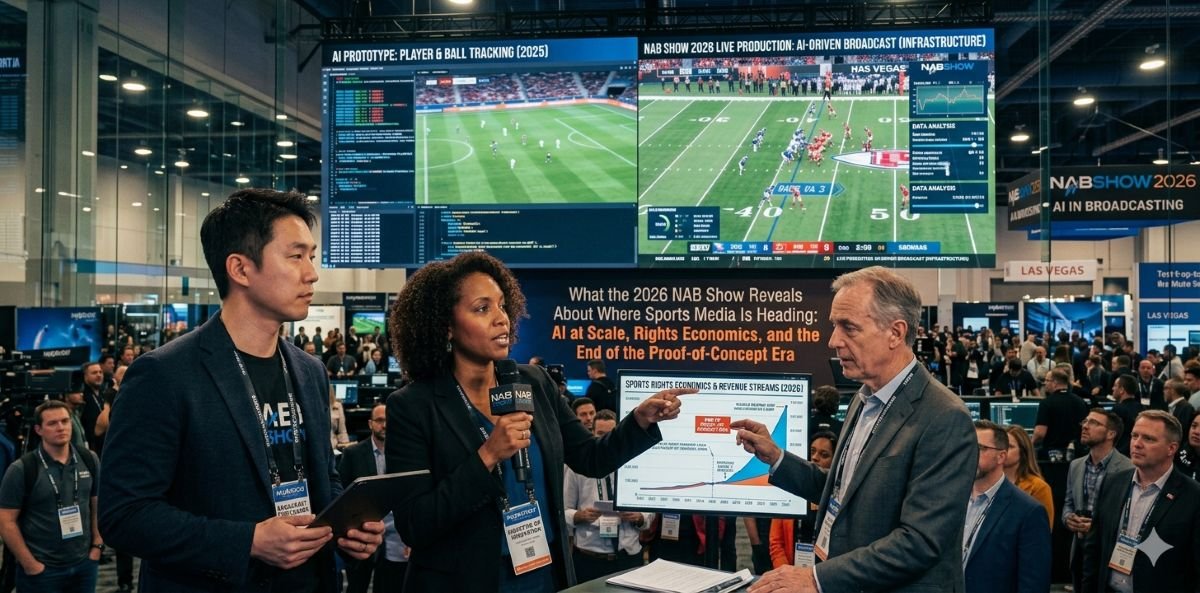

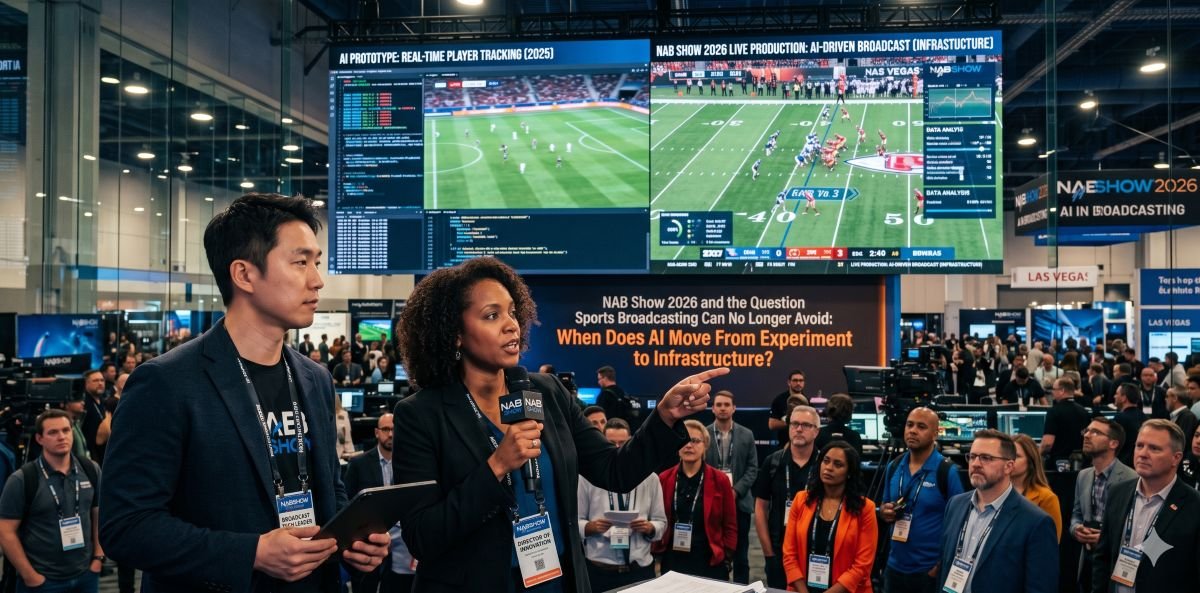
The annual NAB Show has long served as a temperature check for the broadcast and media industry. But the 2026 edition, running April 18 through 22 in Las Vegas, carries a different kind of weight. This year, the question is not whether artificial intelligence belongs in sports broadcasting workflows. That debate is largely settled. The question now is whether the industry can actually deliver on what it has been promising — and what happens to the production teams left managing that transition in real time.
From Pavilion Curiosity to Production Reality
One of the clearest signals of how the conversation has shifted is the composition of exhibitors. The number of AI-focused companies at NAB Show 2026 nearly doubled compared to the previous year. Adobe, AWS, Microsoft, NVIDIA, and Google Cloud are among those demonstrating applied AI tools — not concept demos, but workflows designed for integration into live and post-production environments. The show now features two dedicated AI Pavilions, a structural acknowledgment that AI has moved from a niche interest to a central organizing theme.
The NAB Sports Summit, expanded to a four-day program this year under the title “The Future of Sports Rights and Fan Engagement,” brings together broadcasters, streaming platforms, leagues, and technology partners to examine what these shifts mean for the actual business of sports media. Topics on the agenda include media rights strategy, direct-to-consumer models, and the role of AI in both content creation and rights distribution.
What distinguishes 2026 from previous years is the industry’s collective move away from experimentation language. Where previous NAB Shows featured discussions framed around “piloting AI” or “exploring automation,” this year’s conversations are structured around scale, cost, and workflow integration. The framing has changed from “can this work?” to “how do we make this work consistently, across every event, within existing budgets?”
The Structural Tension Sports Broadcasting Cannot Ignore
That budget question sits at the center of the most honest conversations happening at NAB 2026. Sports production is unique among broadcast environments — it demands more simultaneous feeds, faster turnarounds, and zero tolerance for correction windows. A news program can issue a clarification. A live sports broadcast cannot walk back a missed moment or a delayed graphic.
As Joyce Bente, president and CEO of the Americas at Riedel Communications, framed it ahead of the show, sports production faces a fundamental balancing act: audiences want more content, more camera perspectives, and more immediacy, but production teams are being asked to deliver this without proportionally greater resources. The real innovation challenge is not just technical capability — it is scale. Producing more, more efficiently, without the quality compromises that audiences will notice.
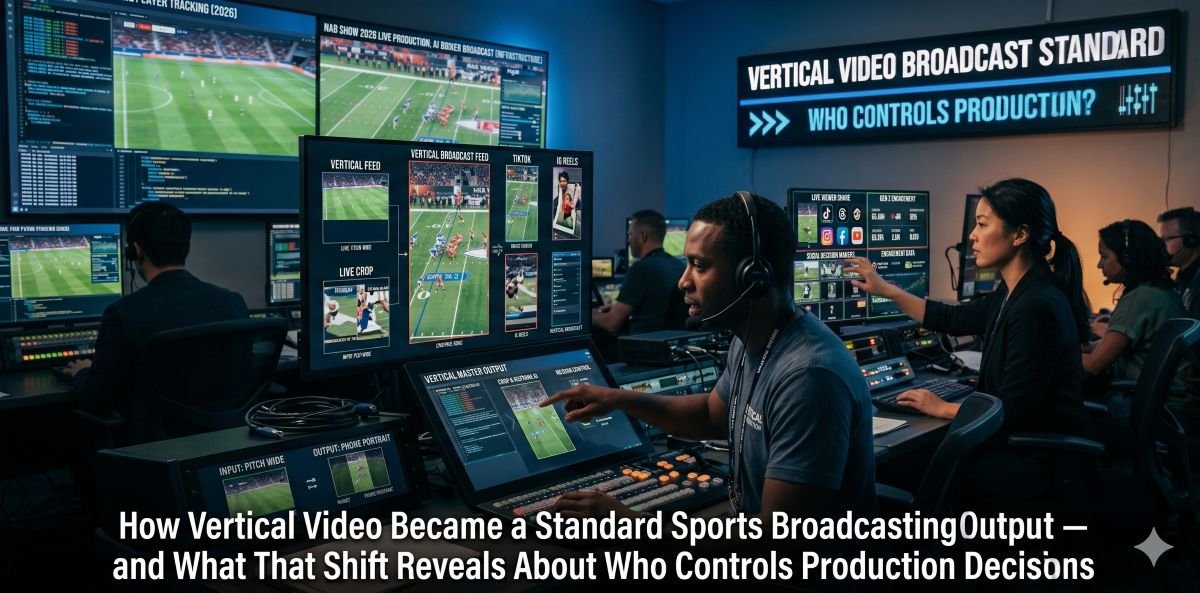
This tension is visible across several production categories. Vertical video optimization is one example. NBCUniversal and Fox Sports Digital have both begun deploying AI tools to adapt live sports feeds for smartphone and social platform delivery — not because they want to, necessarily, but because data consistently shows that streaming content is discovered and consumed primarily on mobile devices. If you do not optimize for that format, you are producing content for a secondary screen and calling it a primary product.
Color management, audio workflows, and remote production infrastructure are all undergoing similar pressure. The technology to improve each of these areas exists. The challenge is implementing it at the pace and scale that live sports requires, with production teams that have not grown proportionally with the ambition of the output.
What This Means for How Sports Content Reaches Audiences
For anyone trying to understand how sports broadcasting actually works — how a match in Seoul becomes a stream on a phone in Anyang — the NAB Show offers a rare window into the industrial layer that most fans never see. The decisions made at conferences like this one shape what sports look like on screen, how quickly statistics appear, whether alternate viewing formats exist, and how reliably streams deliver without buffering or delay.
The broader shift toward AI-assisted production is not just a technology story. It is a story about what sports media organizations believe they owe their audiences, and what they are willing to invest to deliver it. For Korean broadcasters and streaming platforms navigating their own rights and production challenges — a conversation explored in detail at Anyang Insider’s analysis of how SOOP and Chzzk divided the Korean live sports streaming market — the dynamics on display at NAB are not abstract. They are the upstream decisions that eventually determine what Korean fans can watch and how.
The industry is past the point of asking whether AI should be part of sports broadcasting. NAB Show 2026 is where it works out the terms.
For additional context on how sports analytics and data infrastructure are reshaping broadcast production at a technical level, 스포츠 분석 방법론 체계적 이해를 위한 사고 프레임 offers a useful analytical framework for understanding these developments.