Why Korean OTT Subscribers Are Increasingly Signing Up for Sports: What the Tving-KBO Deal Tells Us About Changing Viewer Behavior

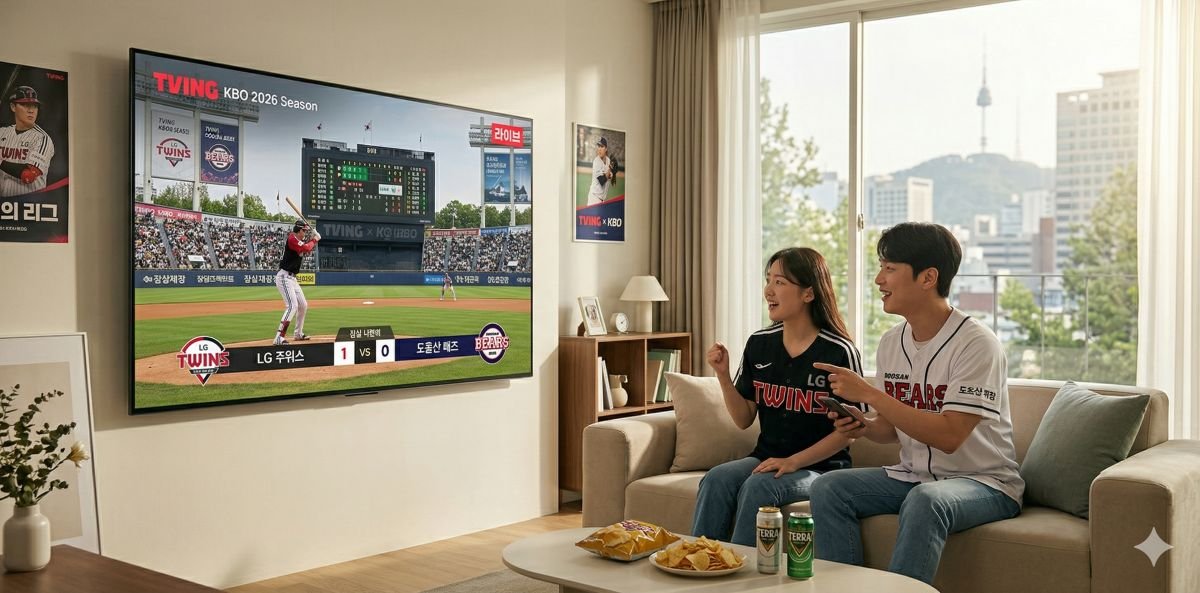
Something measurable has shifted in why Koreans subscribe to streaming platforms. Sports is no longer a secondary feature that occasionally justifies a subscription — it has become, for a growing segment of the market, the primary reason people sign up at all. The Tving-KBO deal and its renewal provide the clearest structural evidence of that transformation.
The Behavioral Data That Changed the Conversation
The shift is documented, not assumed. According to a report published by the Korea Creative Content Agency, 24.3 percent of OTT platform subscribers in South Korea said they subscribe specifically to watch sports broadcasts. That figure represents a sharp increase of 8.9 percentage points from the previous year’s 15.4 percent — a rise of more than half within a single measurement period.
The gender breakdown sharpens the picture further. Among male subscribers, 38.8 percent cited sports as their primary motivation for subscribing to an OTT platform, up 13.8 percentage points from the prior year. That is not a marginal change. It represents a fundamental reorganization of why a significant portion of the Korean streaming audience is paying for digital content services.
For platform operators, this kind of data is not incidental. It is a strategic signal. When a substantial and growing portion of subscribers can point to a single content category as their reason for being on the platform, that content category becomes foundational to retention — not simply additive to it.
The Deal That Tested the Theory
In 2024, Tving signed a three-year exclusive streaming rights contract with the KBO League valued at 135 billion won, approximately 93 million US dollars. The agreement covered the 2024 through 2026 seasons and carried a consequence that Korean baseball fans felt immediately: KBO games, which had previously been available to watch online for free through various portal and telecom partnerships, moved behind a paid subscription paywall for the first time.
This was not a minor adjustment to the viewing experience. It was a structural transformation in how Korean baseball could be accessed digitally. Fans who had never needed to subscribe to anything in order to follow their team now faced a choice: pay for Tving or lose access to live online coverage of 144 regular season games plus the postseason.
The market’s response answered the question that every platform executive running a similar calculation needs answered: would subscribers pay? The behavioral survey data suggests they did, and in growing numbers. The OTT subscription motivation data showing sports as a primary driver tracked directly alongside the KBO paywall era.
The Renewal That Confirms the Model
If the original deal was an experiment, the renewal announced for 2027 through 2031 is the industry’s verdict on the result. Tving agreed to a five-year extension valued at approximately 450 billion KRW — an average of 90 billion KRW per year. That per-season figure is double the value of the original three-year contract.
Rights holders do not double the price of content that failed to generate returns. Platforms do not agree to doubled prices for content they cannot monetize. The renewal valuation is the clearest signal available in the Korean sports media market that the subscription model built around exclusive KBO rights proved commercially viable across its initial three-year run.
This pattern is not unique to Korea. Globally, streaming platforms have identified live sports as the category most resistant to subscription cancellation, most effective at driving new sign-ups, and most capable of justifying price increases. What the Tving-KBO renewal confirms is that the Korean market has now joined that structural reality. Sports rights in Korea are no longer priced as entertainment content. They are priced as subscriber infrastructure.
Read also: https://jejumonthly.com/고객-지원-테스트하기-사이트가-사용자에게-정말-도/
What the Regulator Revealed
The most analytically precise confirmation of this dynamic came not from the platforms or the rights holders, but from the Korea Fair Trade Commission. When the FTC reviewed the proposed merger between Tving and Wavve — two of Korea’s major OTT platforms — it granted conditional approval with a specific condition: the merged entity must maintain current subscription fee levels through the end of 2026.
The reasoning the FTC offered for this condition is the analytically significant detail. The regulator stated explicitly that subscribers who highly value exclusive content, such as KBO League baseball coverage, would find it difficult to switch to alternative platforms. That difficulty — the functional inability to replicate the content experience elsewhere — is what economists and market analysts call a switching cost.
The FTC was not simply worried about price increases in a generic sense. It was recognizing that exclusive sports content creates a category of subscriber who is structurally locked in, not through contract or technical restriction, but through the absence of equivalent content anywhere else. That recognition, coming from an antitrust authority rather than a marketing department, carries particular weight. It confirms that Korean sports broadcasting rights now function as competitive infrastructure in a way that general entertainment content does not.
What This Means for the Broader Market
The three data points — the behavioral survey, the renewal valuation, and the FTC condition — connect into a single coherent story about how the Korean OTT market is being reshaped around sports.
For platform operators, the lesson is that exclusive sports rights are worth paying substantially more for than general entertainment rights, because the subscriber behavior they generate is more durable and more resistant to churn. For rights holders like the KBO, the lesson is that their content commands a different price in a market where platforms have demonstrated willingness to use sports as subscriber acquisition and retention infrastructure.
For fans and industry observers across Gyeonggi-do and beyond, the practical consequence is a streaming landscape increasingly organized around access rather than discovery — where whether you can watch a specific match depends not on what device you own, but on which subscription you hold.
How legal frameworks shape the way audiences interact with content platforms sits beneath all of these dynamics. For analytical context on how regulatory design influences user behavior within competitive digital markets, How Legal Structures Shape User Behavior provides useful structural framing that applies directly to the OTT sports rights environment.
The Tving-KBO deal will not be the last of its kind in Korea. The structural logic it established — exclusive rights, behavioral lock-in, regulatory recognition, rising renewal value — is now the template against which every future Korean sports streaming negotiation will be measured. For more context on how data availability has driven structural changes in content markets, How Data Availability Changed Betting Market Structures offers a parallel framework on how information access reshapes competitive dynamics.