How SOOP and CHZZK Divided the Korean Live Sports Streaming Market — and What the LCK Rights Deal Tells Us About Platform Strategy

The Korean live sports streaming market has undergone a structural reorganization that most casual viewers have not fully noticed. What looks like a simple competition between two platforms is actually a more consequential story about how exclusive broadcast rights have become the primary lever of market control — and what that means for fans in Anyang and across Gyeonggi-do who rely on digital platforms for sports access.
How the Korean Streaming Market Got Here
To understand where things stand in 2026, it helps to understand the disruption that created the current landscape. For years, Twitch held a dominant position in Korean livestreaming, particularly in gaming and esports content. Korean audiences generated enormous viewership hours on the platform, and the ecosystem of streamers, commentary, and community built around it was self-sustaining.
When Twitch exited Korea in early 2024, citing the high cost of maintaining server infrastructure under local data regulations, it left behind a gap that neither a single platform nor an obvious successor could immediately fill. The audience did not disappear — it redistributed. Some moved to YouTube Gaming. The majority split between two Korean-native platforms: SOOP, which had rebranded from its former identity as AfreecaTV, and CHZZK, a streaming service built and backed by Naver, South Korea’s dominant internet company.
That split set the stage for the competition now playing out across the Korean streaming market.
The Two Platforms and Where They Stand
SOOP entered this period with significant advantages. Its history as AfreecaTV gave it decades of brand recognition, an established streamer community, and deep roots in Korean internet culture. The rebrand was designed to modernize its identity and signal global ambitions, and it largely succeeded in consolidating gaming audiences who moved away from Twitch.
CHZZK, by contrast, launched in late 2023 with essentially no legacy audience but with the full weight of Naver’s infrastructure behind it. Naver operates South Korea’s most used search engine, news platform, community boards, and payment systems. CHZZK launched into an ecosystem where its target users already had Naver accounts and were embedded in Naver-adjacent digital habits. Growth was rapid.
By early 2026, the two platforms operate at broadly comparable scale — a remarkable outcome for a service that did not exist before December 2023. CHZZK leads SOOP in total active channels and breadth of gaming content. SOOP maintains a slight edge in average concurrent viewership. On most meaningful metrics, the two platforms are genuinely competitive with each other, which is itself a significant structural development in a market that had previously been dominated by a single foreign platform.
Read also: https://daejeoninsider.com/카지노사이트-라이선스-진위-판별법/
The LCK Deal: Rights as Infrastructure
The most consequential single development in the Korean streaming landscape for 2026 is not a product feature or a streamer signing. It is a broadcast rights agreement.
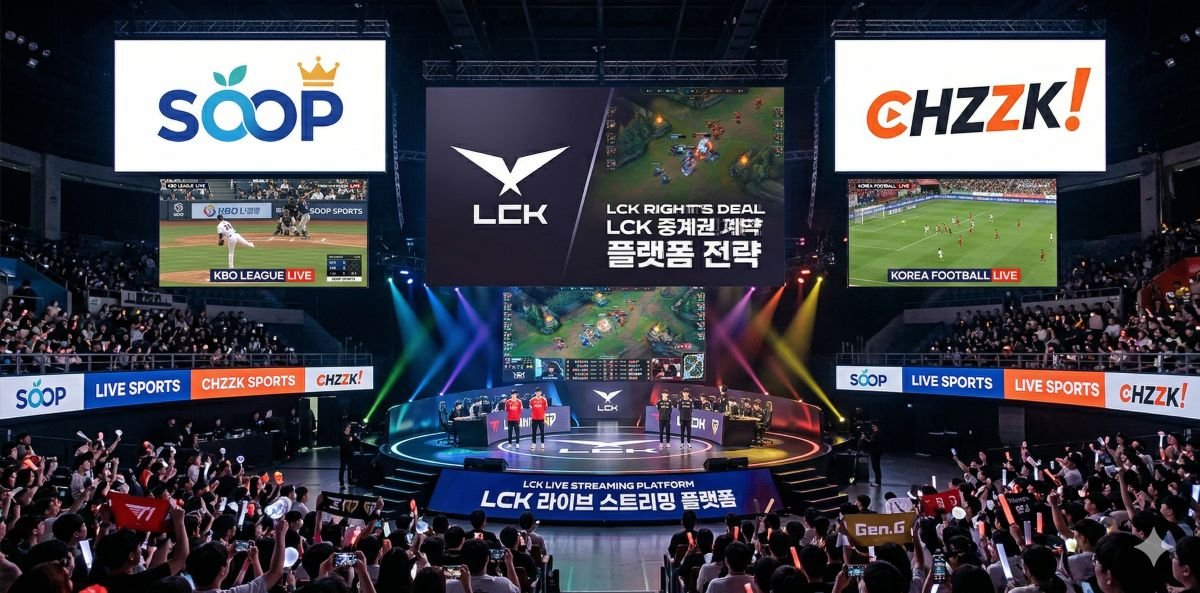
Naver, through CHZZK, secured exclusive Korean-language broadcast rights to the League of Legends Champions Korea — the LCK — from 2026 through 2030, as part of a joint agreement that also includes SOOP Korea. The LCK is the single most-watched esports property in the Korean market. League of Legends viewership on Korean platforms consistently generates more hours watched than any other category, and the LCK sits at the top of that ecosystem.
The structural consequence of this deal is significant and deliberately constructed. Starting in 2026, YouTube is no longer a competitor for LCK content in the Korean language. Viewers who want to watch LCK matches through official Korean-language broadcasts must use either SOOP or CHZZK. The rights deal does not simply give these platforms premium content — it removes that content from every alternative and concentrates audience access within a defined duopoly.
This is what it means to use broadcast rights as competitive infrastructure rather than as a content supplement. The deal does not just attract viewers to these platforms; it structurally eliminates the option of going elsewhere. During the EWC 2025 League of Legends grand final, CHZZK alone drew over 360,000 Korean-language concurrent viewers — a figure that demonstrated the platform’s capacity to deliver at scale before the LCK exclusivity even took full effect.
The Pattern Extends Beyond Esports
The LCK deal is the most visible example of a broader dynamic operating across Korean digital media. When JTBC withdrew from broadcasting the 2026 Winter Paralympics due to profitability concerns, SOOP and CHZZK stepped in to acquire those rights. Traditional broadcast infrastructure retreated, and digital streaming platforms filled the gap — not through charity, but because acquiring rights that establish viewer habit and platform dependency is strategically valuable even when individual event viewership is modest.
This pattern — incumbent broadcasters retreating from secondary events and streaming platforms absorbing those rights — is accelerating. Each acquisition reinforces the habit of turning to digital platforms for sports access, which in turn makes those platforms more attractive for the next rights negotiation.
For fans in Anyang and surrounding Gyeonggi-do communities, this structural shift has direct practical consequences. The platforms that hold broadcasting rights determine what content is accessible, on what devices, and under what subscription or registration conditions. Understanding how rights deals function — not as passive content arrangements but as active tools of audience capture — is the foundational analytical skill for navigating sports media in 2026.
What Legal Structure Has to Do With It
The competitive dynamics between SOOP and CHZZK do not exist in a policy vacuum. The regulatory environment that governs Korean digital platforms shapes what rights deals are permissible, how exclusive arrangements are structured, and what obligations platforms carry toward users. How legal structures shape the behavior of users and platforms within competitive markets is a question that runs beneath the surface of every major streaming deal. For analytical context on that dimension, How Legal Structures Shape User Behavior provides useful framing on the relationship between regulatory design and audience engagement patterns.
The rights-driven reorganization of Korean sports streaming is still in early stages. The LCK exclusivity runs through 2030. The habits being built now — which platform fans reach for first, which interface feels native, which notification they tap when a match goes live — are the behavioral infrastructure that will determine market structure well beyond the current contract cycle.
Meta Title: How SOOP and CHZZK Divided Korean Sports Streaming — The LCK Rights Deal Explained
Meta Description: The Korean live sports streaming market has been reshaped by exclusive broadcast rights deals. This analysis explains how SOOP and CHZZK are using the LCK agreement as competitive infrastructure — and what it means for sports fans across Gyeonggi-do.
Target Keywords: SOOP CHZZK Korean streaming market, LCK broadcast rights 2026, Korean live sports streaming, CHZZK SOOP comparison, Korean esports streaming platforms, LCK exclusive rights Korea, AfreecaTV SOOP rebrand, Naver CHZZK sports rights, Korean streaming market analysis, sports broadcasting rights Korea
Suggested URL: /soop-chzzk-korean-sports-streaming-lck-rights-deal-explained