

MLB’s Automated Ball-Strike System Is Live in All 30 Ballparks — What the Technology Architecture Tells Us About Where Sports Officiating Data Is Heading

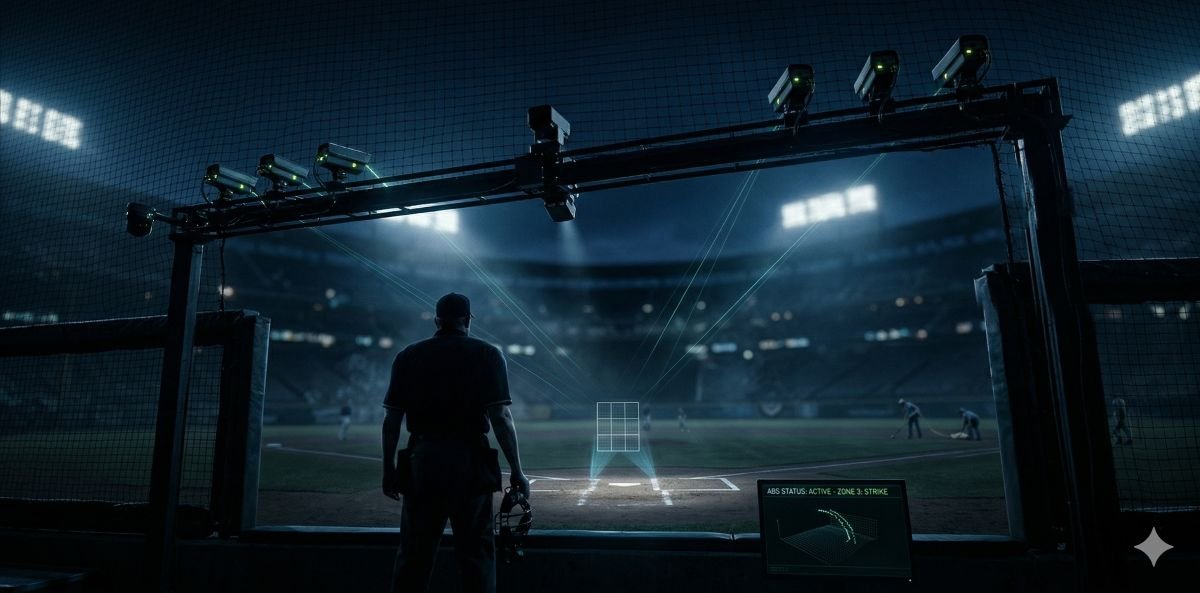
The 2026 MLB season marks the first time all 30 franchises have simultaneously used an automated pitch-calling system — a reform that is not simply about replacing human umpires on ball-strike calls, but about what happens when real-time tracking data becomes the authoritative source of truth in a live sporting event.
The Most Consequential Officiating Reform in 76 Years
To understand the significance of MLB’s Automated Ball-Strike system going league-wide in 2026, it helps to have a reference point for scale. The last officiating reform of comparable structural consequence in American baseball was the standardization of the strike zone across the American and National Leagues in 1950. That change established a uniform definition of the zone that umpires would apply by human judgment. The 2026 ABS rollout does something categorically different — it removes human judgment from the ball-strike determination entirely and replaces it with a dual-technology tracking framework operating in real time.
This is not an incremental adjustment to how baseball is officiated. It is a redefinition of what officiating means in the context of a sport where the most frequent and consequential decisions — whether a pitch is a ball or a strike — now originate from a sensor array rather than a human observer.
The Technology Architecture
The ABS system operates through a dual-technology framework that combines two distinct tracking methodologies. TrackMan Doppler radar tracks the ball through its entire flight path, measuring velocity, spin rate, movement, and three-dimensional position as the pitch travels from the pitcher’s hand to the plate. Hawk-Eye optical tracking cameras, mounted at a minimum of twelve fixed positions within each ballpark, provide a complementary visual tracking layer that captures the ball’s position from multiple angles simultaneously.
The two systems work in combination to generate a pitch-location determination within approximately 50 milliseconds of the ball crossing the plate. To put that figure in context, the average human blink takes between 150 and 400 milliseconds. The system produces its call faster than the human eye can close and reopen. The determination is then communicated to the home plate umpire through an earpiece, who announces the call in the conventional manner — but the decision itself originated from the sensor array, not from the umpire’s visual assessment.
This architecture has direct implications for how live sports data is generated, transmitted, and used. The question of how data latency affects the integrity and experience of live sports systems is one that extends well beyond baseball officiating. The analysis of data delay and the competition for speed in live sports data environments examines the broader structural dynamics of real-time sports data systems — dynamics that the ABS architecture illustrates with particular clarity.
The KBO Connection — Korean Baseball Audiences Already Know This Technology
One dimension of the ABS story that receives insufficient attention in American baseball coverage is that this technology is not new to Korean baseball audiences. The KBO League in South Korea has already used automated ball-strike systems, meaning that Korean fans have direct, practical familiarity with the underlying technology now arriving at the major league level in the United States for the first time.
For Anyang audiences — where baseball culture is embedded in the broader Gyeonggi Province sports community — this creates a distinctive vantage point on the MLB story. Korean fans are not encountering ABS as a foreign or experimental concept. They are watching American baseball adopt something that Korean baseball has already normalized, and they are positioned to evaluate the MLB implementation against a baseline of lived experience with how the system actually functions in a professional league environment.
This reversal of the typical technology diffusion pattern — where innovations originate in major American leagues and eventually reach Asian leagues — is worth noting. In the specific case of automated officiating technology, the KBO was ahead of MLB. Korean baseball fans watched this system develop and be refined before it reached the world’s largest professional baseball league.
Early Results — 94 Overturned Calls in 47 Games
The early data from the 2026 MLB season provides a concrete measure of how frequently the ABS system is producing different outcomes from what human umpires would have called. In the first 47 games of the season, 94 calls were overturned out of 175 challenges. That is a correction rate of approximately 54 percent on challenged calls — meaning that when players or managers activated the challenge mechanism to contest a ball-strike call, the ABS determination differed from the on-field call more than half the time.
Fan reaction in stadiums and on broadcast has been described as enthusiastically positive. The real-time nature of the challenge system — in which a contested call is reviewed and a determination delivered within seconds — creates a distinct moment of collective engagement in the ballpark. The crowd watches, the result is announced, and the response is immediate. This dynamic is structurally similar to the VAR review moments that have become embedded in football culture globally, where the technology intervention creates a pause that generates its own form of fan participation.
What the Architecture Reveals About the Direction of Sports Officiating
The ABS system illustrates a broader trajectory in how sports officiating is being redesigned around data infrastructure. Several structural patterns are visible in the MLB implementation that are likely to appear in other sports contexts.
Sensor redundancy is a design principle, not a luxury. The combination of TrackMan radar and Hawk-Eye optical cameras is not accidental. Using two distinct tracking methodologies that operate on different physical principles provides a cross-validation layer that neither system could offer alone. When the two systems agree, confidence in the determination is high. When they diverge, the system has a mechanism for flagging uncertainty rather than producing a potentially incorrect authoritative call.
Speed of determination matters differently in officiating than in analytics. Sports data analytics can tolerate processing delays because the output is used after the fact. Officiating data cannot — the determination must arrive before the next action in the game begins. The 50-millisecond output of the ABS system is not a performance benchmark chosen arbitrarily. It is the minimum threshold required for the determination to function as an officiating tool rather than a post-hoc review mechanism.
The challenge mechanism is a human interface layer on top of an automated system. MLB did not implement ABS as a fully automatic system in which every pitch is called by the sensor array without human involvement. The home plate umpire still announces every call. The ABS determination is only surfaced when a challenge is made. This design choice reflects an understanding that the social and theatrical dimensions of officiating — the umpire’s authority, the drama of a disputed call — have value that pure automation would eliminate.
The Anyanginsider Dimension
For readers following Korean sports technology and the evolution of how domestic leagues compare with international counterparts, the ABS story connects directly to ongoing discussions about how Korean sports institutions adopt, adapt, and sometimes lead on officiating and data infrastructure. AnyangInsider’s coverage of sports technology and data developments in the Korean sports context provides a local lens on these broader industry trends, including how KBO’s early adoption of automated officiating positions Korean baseball audiences as informed observers of the MLB transition now underway.
As the 2026 season progresses and more data accumulates on ABS accuracy, player adaptation, and fan response, the Korean baseball community’s prior experience with the technology will become an increasingly relevant reference point for evaluating how the system is performing at the major league level.