

How K League Is Using Generative AI to Transform Its Broadcast Identity — and What That Signals for Sports Media Production

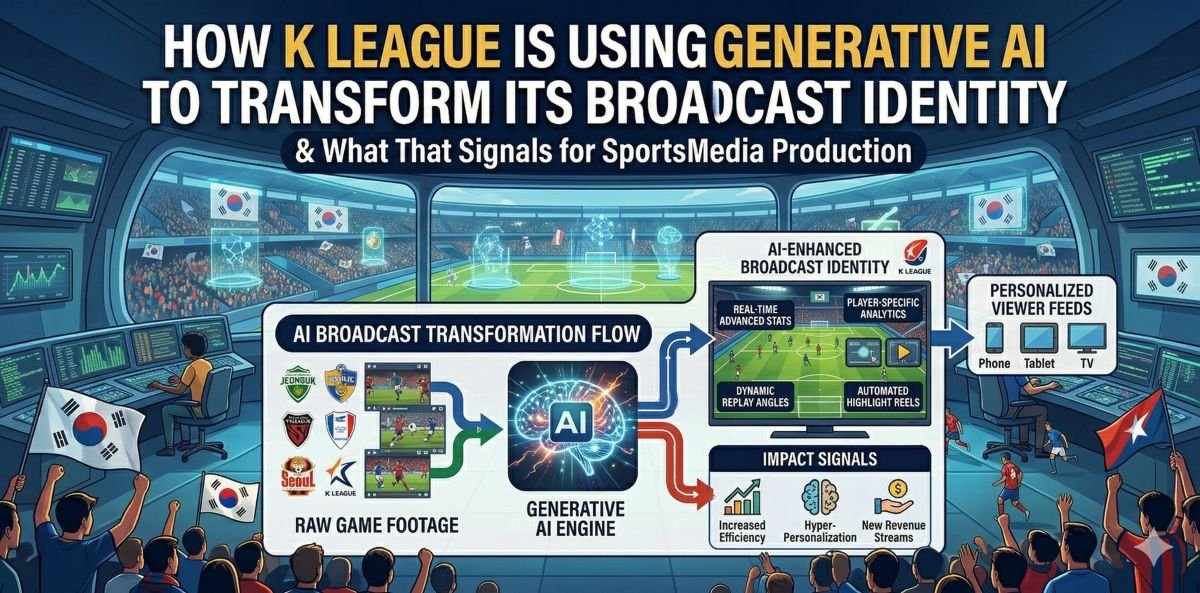
The K League’s 2026 season officially opened with a first in Korean football: a generative AI-produced intro video unveiled at the league’s Media Day event and deployed as the broadcast opening for the entire season. For an industry that has spent years discussing AI’s potential in sports, this marks a concrete step — and one that reflects a much broader shift in how leagues around the world are approaching content production.
What the K League Actually Did
At this year’s Media Day event, the official intro video of the 2026 season incorporating generative AI technology was released for the first time. The video, which captures the dynamics of the K League and the passion of fans with visual effects, will be used as a broadcast opening throughout the season.
The Korea Professional Football Federation also announced a major overhaul of K League broadcasting for the 2026 season more broadly — replacing graphics for the first time in five years since the introduction of unified broadcast graphics in 2021, and introducing special cameras designed to convey the dynamics of live play. Using an AI-based tracking system, player movements are provided in real-time graphics during broadcasts.
The AI intro video drew mixed reactions. Fans immediately applauded at the Media Day venue, but criticism followed on football community forums and the official K League YouTube channel. Viewers pointed to issues including awkward AI-generated gestures from players, incorrect stadium backgrounds assigned to clubs, and overall visual quality that fell below expectations — particularly given the disclosed production budget of 100 million won. The federation acknowledged the feedback and indicated it would consider revisions.
That tension — between the ambition of AI-generated visual identity and the current limitations of the technology — is itself instructive. It illustrates precisely where the sports media industry is right now: committed to the direction, still working through the execution.
What Generative AI Does in a Broadcast Context
To understand what the K League is actually attempting, it helps to understand what generative AI means in a media production context. Unlike traditional video production, which requires human editors, motion designers, and production crews to assemble footage, generative AI systems create visual content from learned patterns. They can produce sequences, textures, and visual effects based on prompts or source material — significantly reducing production time and cost.
AI-driven content platforms can plug into a league’s live video feed and instantly create highlight videos customized for any audience. In the first half of 2025 alone, one major AI sports platform generated over 8 million video clips for its partners — a 52% year-over-year increase — without requiring growth in editorial staff.
Beyond highlights, the technology is being applied to broadcast identity itself — the visual language that defines how a league looks and feels on screen. This is where the K League’s 2026 initiative sits: using generative AI not just as a content accelerator, but as a creative tool for the league’s own brand presentation.
Generative AI shifts the optimization problem in broadcast production by addressing what compression removes rather than simply how it removes it. Models learn the structure of high-quality video and use that understanding to reconstruct detail lost along the way — an approach that aligns well with sports, where motion is fast, textures are complex, and source quality is often uneven.
How Other Major Leagues Are Moving in the Same Direction
The K League’s decision does not exist in isolation. Across the global sports media industry, leagues and broadcasters have been accelerating AI adoption at the content production level.
Ahead of the 2025-26 season, Amazon rolled out an AI-led broadcast feed providing real-time tactical insights for the UEFA Champions League. The NBA has deepened its partnership with Amazon Prime and AWS to explore AI-driven production and data integration.
LaLiga has partnered with Microsoft to integrate AI into its operations, including match analysis, predictive analytics, and media production enhancements. Bundesliga is working with AWS to leverage AI for driving fan engagement and providing advanced data services.
At the FIFA World Cup 2026, planned AI deployments include enhanced digital broadcast visualization, intelligent operational command centers, and generative AI analytics platforms designed to manage massive real-time data volumes across venues and global media networks.
What the K League is doing at the intro video level, major global properties are doing across their entire broadcast infrastructure. The direction is consistent. The scale differs, but the underlying logic is the same: AI reduces production cost, accelerates content output, and enables leagues to build a more distinct and scalable visual identity across platforms.
Why This Matters for Sports Media Production
The K League’s AI intro is not simply a technology story. It signals a structural change in how sports organizations think about content ownership. When a league produces its broadcast identity using generative AI tools, it is taking more direct control over the visual language that represents it — rather than relying entirely on external production agencies working on traditional timelines.
Leagues that adopt AI-driven content pipelines report that tailored content can drive significant increases in video consumption, with the NBA’s personalized highlight system tripling app engagement and increasing total video views by around 700%.
In 2026, generative video is moving from a supporting role to a leading one. Experiments using it to create scenes and visual effects are breaking into primetime, with entertainment executives believing it will enable content to become richer rather than simply cheaper — though the technology remains contested.
For Korean football specifically, this development arrives at a significant moment. The 2026 season is the last under the current 12-team format, with structural changes coming in 2027. Bucheon FC 1995 is competing in the top flight for the first time. The audience for K League content — both domestic and international — is at an inflection point. Investing in broadcast identity now, even with the imperfections the AI intro exposed, reflects a longer-term calculation about how the league wants to present itself as it grows.
For readers across Gyeonggi-do interested in how digital media structures and online platform growth are reshaping content markets, anyanginsider.com has a useful overview of how digital experiences and regulatory frameworks shape the way content reaches audiences across different regions.
The K League’s generative AI experiment, criticism and all, positions Korean football as an early adopter in a shift that will define sports media production for the next decade. The technology will improve. The economics already make sense. And the leagues that establish their AI-driven content pipelines now will carry a structural advantage when scale becomes the defining challenge. For more on how digital infrastructure is reshaping sports media economics, economicseoul.com has examined the structural drivers behind digital platform growth in the sports and entertainment space.