

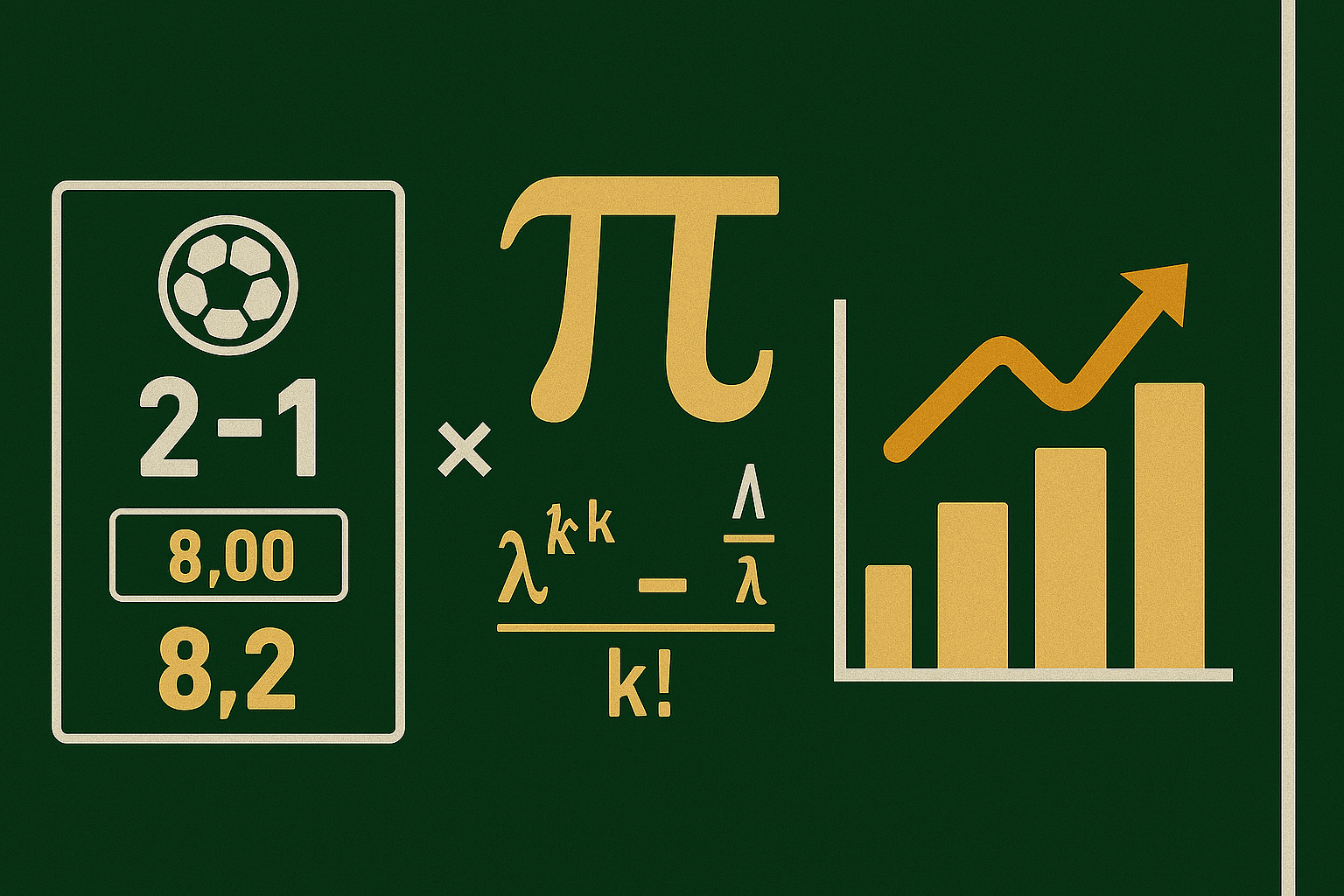
Scoreline odds come from a mathematical formula called the Poisson distribution, which uses a team’s historical scoring and defending data to predict the chance of an exact result. By looking at how many goals a team is expected to score on average, bookmakers can calculate the probability of specific outcomes like 1-0 or 2-1. This process turns a complex sports match into a series of numbers that represent the likelihood of every possible score, allowing the betting market to set prices that reflect the risk of each specific result.
The Foundation: Expected Goals
Before a bookmaker can set odds for a correct score, they must first determine how many goals each team is likely to score. This is done by looking at “Expected Goals” or xG. To find this number, analysts look at a team’s attacking strength and the opponent’s defensive strength. If a team usually scores two goals against average opponents, but they are playing against a team with a very strong defense, their expected goals for that specific match might drop to 1.2 or 1.4.
This number is the average. However, in a real game, a team cannot score 1.4 goals. They can only score zero, one, two, or more. This is where the math becomes interesting. The bookmaker needs a way to turn that average of 1.4 into a list of probabilities for every possible whole number of goals.
Using the Poisson Distribution
The most common tool for this calculation is the Poisson distribution. This is a mathematical concept used to predict how many times an event will happen within a fixed period of time. In football, that period is 90 minutes. The formula assumes that goals are independent events, meaning that scoring one goal does not change the probability of scoring another one later.
Joseph Buchdahl, a well-known sports betting analyst, explains that the Poisson distribution is the cornerstone of sports modeling because it treats goals as events that happen randomly but at a known average rate. He notes that while it is not a perfect system, it provides a very reliable starting point for setting odds in low-scoring sports like football or hockey.
Original Data: From Averages to Probabilities
To see how the math works, we can look at a team that has an expected goal average of 1.5 for a match. Using the Poisson formula, we can calculate the probability of that team scoring a specific number of goals.
| Number of Goals | Probability (%) | Odds Equivalent |
| 0 Goals | 22.3% | 4.48 |
| 1 Goal | 33.5% | 2.99 |
| 2 Goals | 25.1% | 3.98 |
| 3 Goals | 12.6% | 7.94 |
| 4 Goals | 4.7% | 21.28 |
| 5+ Goals | 1.8% | 55.56 |
Once the bookmaker has these percentages for both the home team and the away team, they simply multiply them together to find the chance of an exact score. For example, if the home team has a 20% chance of scoring one goal and the away team has a 20% chance of scoring zero goals, the chance of a 1-0 result is 4%.
Expert Insights on the Math
David Sumpter, a professor of mathematics and author of books about football data, says that math helps us see that while goals feel random, they follow patterns that we can measure over hundreds of matches. He explains that by using these models, bookmakers can remove human emotion from the process. They do not care about the fame of the players; they only care about the numbers the players produce.
Another expert in the field, Dr. Ian McHale, has pointed out that while Poisson is good, it has some limits. He mentions that the model often underestimates the number of draws in a match. In real life, if a game is 1-1 in the 80th minute, both teams might stop attacking to make sure they do not lose. The mathematical model does not know about this human behavior, so bookmakers often have to adjust the numbers slightly to account for it.
Adding the Bookmaker’s Margin
After the math provides the “true” probability, the bookmaker must adjust the odds to ensure they make a profit. If the math says a 2-1 score has a 10% chance of happening, the fair odds would be 10.00. However, the bookmaker might offer odds of 8.00 or 8.50.
This difference is the margin. In correct score betting, the margin is usually quite large because there are so many possible outcomes. If a bookmaker makes a small mistake on one score, they could lose a lot of money, so they protect themselves by offering lower odds than the math suggests. Joseph Buchdahl often warns that the house edge in correct score markets is frequently over 15%, which is much larger than the 2% or 5% found in simpler bets.
Storytelling: The Case of the Missing Goal
Imagine a match between a top team and a team at the bottom of the league. The math might suggest that the most likely score is 3-0. The odds for 3-0 are set at 7.00. For 89 minutes, the top team leads 3-0. The people who bet on that score are feeling confident. Then, in the final minute, a tired defender accidentally trips an opponent, and the referee gives a penalty.
The penalty is scored, and the game ends 3-1. The mathematical model was almost right, but the reality of the game changed the result in a second. This is why correct score odds are so high. The math can tell you what is likely to happen, but it cannot predict the small human errors that happen at the end of a long game. The “Expected Goals” were correct, but the “Actual Goals” were different because of a single moment of chance.
Why the Math Matters to Bettors
Understanding how these odds are created helps a person see that they are playing against a computer model, not just a person making a guess. The bookmakers use millions of data points from thousands of past games to make their Poisson models as accurate as possible.
Calculate the attacking and defensive strength of both teams.
Determine the average expected goals for each side.
Use the Poisson formula to find the probability of every goal count.
Multiply the individual goal probabilities to find the scoreline chance.
Subtract a percentage for the bookmaker’s profit.
While it is impossible to know the future, knowing the math behind the odds allows a person to see which scores are priced fairly and which ones are simply traps. The beauty of sports is that the players do not know the math, and they often do things that the formulas never expected.